What is an AI agent? A practical definition.
Agents are not chatbots, copilots, or "AI features." A clear definition, three properties that separate agents from everything else, and what they let businesses do.
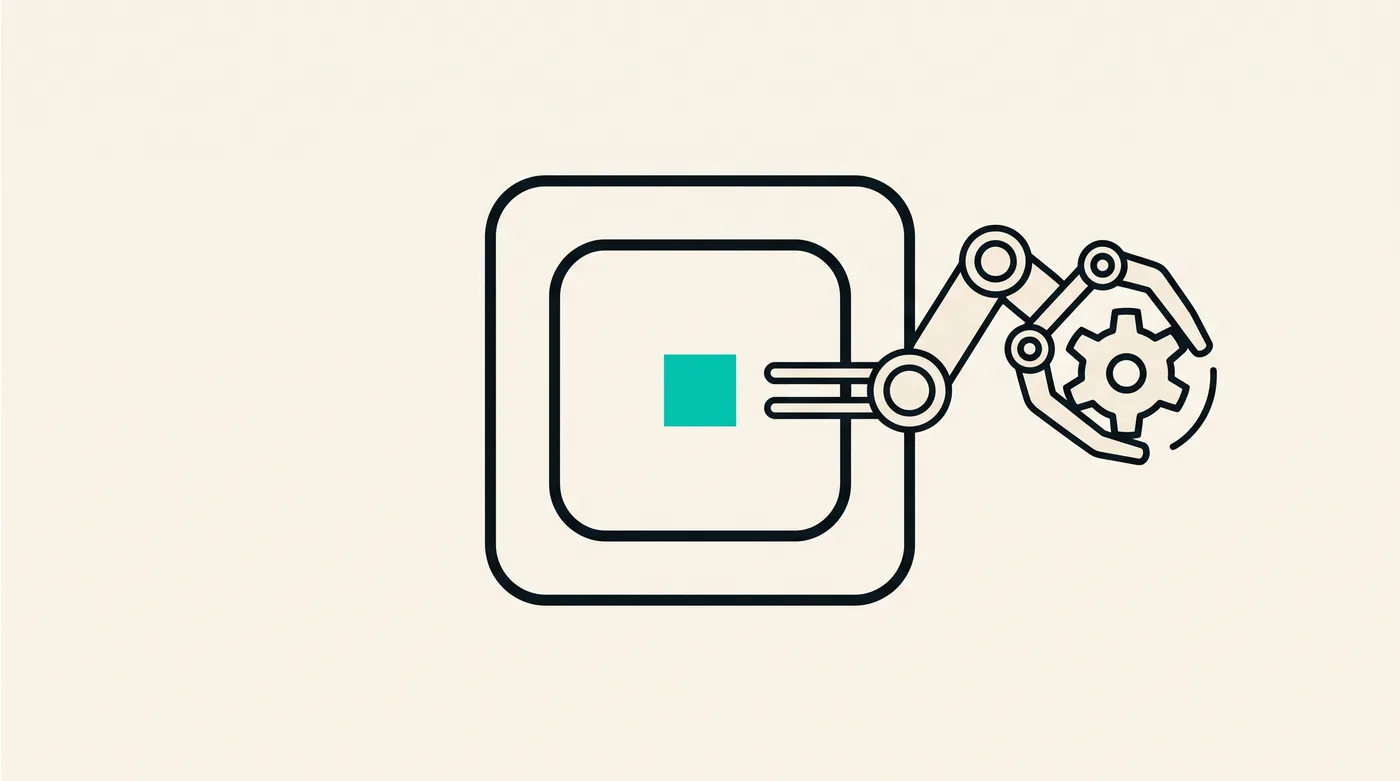
- An AI agent is software that perceives, decides, and acts toward a goal — without a human in the loop for every step.
- Agents are not chatbots, copilots, or "AI features." Three properties separate agents from everything else.
- Agents are useful when a task is repeated, well-bounded, and has reversible (or human-approvable) outcomes.
- What is hype: AGI-style "do anything" agents. What is real: narrow agents that own one task end-to-end.
"AI agent" is the most over-used term in tech right now. Every vendor with a chatbot calls it an agent. Every consulting deck has an "agentic" page. The result is that the word lost its meaning before most people had a chance to learn it.
Here is the working definition we use, and the three properties that actually matter. After this you should be able to tell a real agent from a marketing rebrand in about a minute.
The working definition
An AI agent is software that:
- Perceives — reads its inputs (text, structured data, tools, events).
- Decides — chooses the next action toward a goal.
- Acts — does the thing (calls an API, sends a message, files a document, updates a record).
It then loops. The acting changes the world, which changes what the agent perceives next. The cycle repeats until the goal is reached or a stopping condition triggers.
The three properties that separate agents from non-agents
1. Autonomy in the loop
A chatbot waits for a user input, generates a reply, stops. That is a request-response system. An agent runs without a user input on every step — it decides what to do next based on what it just observed. Humans may be in the loop for approvals; they are not in the loop for every micro-decision.
2. Tool use
An agent acts on the world. That means it calls tools — APIs, databases, code interpreters, browsers, other agents. A model that only outputs text is not an agent; it is a language model. The moment a system gives a language model real tools, the system becomes agent-shaped.
3. Goal-directedness
An agent has a goal. "Triage this support ticket," "draft a marketing email and post it," "reconcile this batch of invoices." The agent picks actions because they move toward the goal — not because they were programmed step-by-step.
Take away any of these three properties and you have something else. Take away tool use, you have a chatbot. Take away autonomy, you have a copilot. Take away the goal, you have a script that calls APIs.
What agents are not
Not chatbots
Chatbots are conversational request-response systems. They do not act on the world; they answer. A chatbot that searches your knowledge base is still a chatbot. A chatbot that, after reading the question, books the appointment, sends the confirmation, and updates the CRM is an agent.
Not copilots
Copilots assist a human who is actively driving. The human writes the next line; the copilot offers a suggestion. Agents do not need the human in the chair — though good agent design keeps the human on the approval queue for high-stakes actions.
Not "AI features"
A button that summarises a document is an AI feature, not an agent. The button does one thing, then waits for the next click. An agent might read the document, decide it needs to be filed in three places, route it, alert the right person, and update three systems — without anyone clicking three buttons.
When agents are useful
Agents earn their place when the task is:
- Repeated. A one-off task does not need an agent; just do it.
- Well-bounded. The space of possible actions is finite and described. "Reply to support tickets" is bounded. "Run the company" is not.
- Reversible or human-approvable. If the agent gets it wrong, you can either undo it or catch it before it ships.
- Worth the engineering. A daily task that takes 30 minutes is not worth a custom agent. A daily task that takes 4 hours is.
What agents look like in our products
At Xwits, the AI engineering platform behind Xwits Engineering is itself a multi-agent system — five specialised agents that share the software-delivery pipeline. Each owns one stage (spec, architecture, build, review, deploy) and hands off to the next.
Inside our products, agents show up as:
- Support agents in XWFit and XWGlow — read incoming customer messages, classify, draft, escalate to a human if uncertain.
- Filing agents in XWFin — read receipts, categorise, flag anomalies, draft the GSTR for review.
- Marketing agents in Marketing Autopilot — plan a campaign, draft the content, queue it across channels, observe the results, suggest the next move.
In every case the human owns the high-stakes decisions and the brand voice. The agents own the routine work that compounds in cost as you grow.
What is hype, what is real
Hype: AGI-style "do anything" agents that handle your whole business. Not real, not soon.
Real: narrow agents that own one task end-to-end, run reliably for months, are observable, are off-switchable, and have a clear human-approval gate where it matters. This is the bar for production-ready agents today. Anyone selling something further on the hype scale is selling you their roadmap.
What this means for you
- If a vendor says "AI agent," ask: what tools does it call, what is the goal, what is the approval gate?
- If you want to deploy an agent yourself, pick one repeated, bounded, reversible task. Not five at once.
- If you want a custom agent for your business, talk to us about a custom build.
- For the broader frame, read What is an AI-native company? and Build vs buy AI.
Book a 30-minute call if you want to walk through whether a specific task in your business is agent-shaped.
Related from the blog

What is an AI-native company?
AI-native is more than a buzzword. We unpack the five real characteristics, how AI-native companies operate day to day, and what it takes to become one.
What is an AI-enabled company?
Most businesses do not need to rebuild from scratch. AI-enabled is the practical starting point. Here is what it looks like with real examples.
Build vs buy AI: a decision framework
When does an off-the-shelf vertical app win? When do you need a custom build? Seven criteria, a scoring rubric, and an honest answer.
Talk to a real engineer.
A 30-minute call. We will tell you honestly whether AI is the right fix and what it would take.