Build vs buy AI: a decision framework
When does an off-the-shelf vertical app win? When do you need a custom build? Seven criteria, a scoring rubric, and an honest answer.
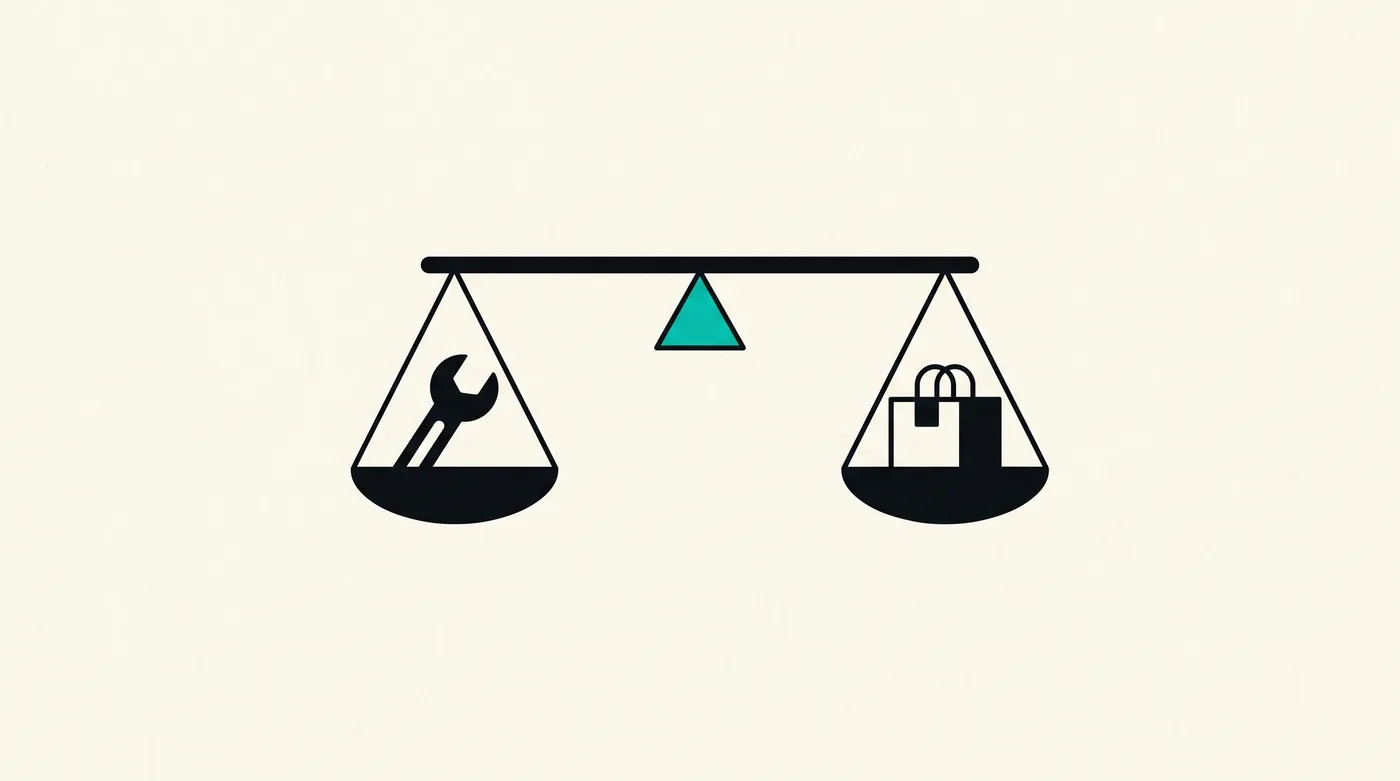
- Seven criteria. Score each one 1-5. Add the total.
- ≤ 17: buy a vertical product. 18-26: hybrid. ≥ 27: custom build.
- The single most important factor is whether your edge depends on the AI being uniquely yours.
- You can change your mind later. Both paths are reversible.
Build or buy is one of the most asked questions when a business starts thinking about AI. It is also the question most consultants get wrong — usually because they make money on one side of it.
We build both. We sell off-the-shelf vertical products under XWorks Suite and we ship custom AI on the same engine. We have no financial incentive to recommend one path over the other. Here is how we actually think through it.
The seven criteria
Score each one from 1 (off-the-shelf wins) to 5 (custom wins). Add at the end.
1. Time to value
How fast do you need this in production?
- 1: "We want it next month or it does not matter."
- 5: "We can wait six months if it is the right thing."
2. Customisation depth
How specific is your workflow to your business?
- 1: Standard industry workflow. Looks like 90% of competitors.
- 5: Your competitive edge is in the unique process. Nobody else does it this way.
3. Data sensitivity
How sensitive is the data the AI touches?
- 1: Public-ish data. Customer-facing communication, marketing copy.
- 5: Highly regulated. Healthcare records, financial data, legal opinions.
4. Total cost over 24 months
Off-the-shelf is cheap upfront, expensive at scale. Custom is the opposite. At your projected scale, which wins?
- 1: Off-the-shelf monthly fees stay reasonable at your scale.
- 5: Off-the-shelf would cost more than building your own over 24 months.
5. Integration complexity
How deeply does the AI need to integrate with your existing systems?
- 1: A few standard integrations (CRM, email, payments). All exist as off-the-shelf connectors.
- 5: Deep integration into proprietary internal systems or unusual third-party APIs.
6. Team capacity
Do you have an engineering team that can manage a custom build?
- 1: No engineers. The closest we have is a tech-savvy office manager.
- 5: Strong engineering team. They want to own this.
7. Exit cost
If you walk away from the choice in two years, what is the cost of switching?
- 1: Low. Off-the-shelf vendor has reasonable export and we can switch in weeks.
- 5: High. Whatever we pick will live in our workflow for 5+ years.
Read the score
| Total | What to do | Why |
|---|---|---|
| ≤ 17 | Buy. Use a vertical product like one of ours. | Off-the-shelf gives you 80% of the value at 20% of the cost and 10% of the time. |
| 18-26 | Hybrid. Use an off-the-shelf product as the base, get specific customisations. | You need most of what exists, plus 1-2 things that are uniquely yours. |
| ≥ 27 | Build. Commission a custom AI. | Your edge is the AI being uniquely yours. Off-the-shelf becomes a ceiling. |
The single criterion that matters most
If you only weight one criterion, weight customisation depth. Everything else can be worked around. If your business edge depends on the AI being uniquely yours — your data, your workflow, your model — then off-the-shelf will become a ceiling within 12 months. If it does not, off-the-shelf will keep up with you longer than you expect.
When buy wins (most of the time)
Buying off-the-shelf is the right call when:
- Your industry is well-understood. The pattern of work is standard.
- You compete on execution and customer experience, not on technology.
- You are early in your AI journey and want a fast learning loop.
- You do not have the engineering team to run a custom build.
This describes most operators — small gyms, salons, clinics, restaurants, retail, finance practices. XWorks Suite exists for exactly this.
When build wins
Custom builds are the right call when:
- Your competitive edge is the AI itself. Customer experience comes from a uniquely-trained model or a uniquely-instrumented workflow.
- Your industry has no off-the-shelf product, or the off-the-shelf options have a clear ceiling.
- The integration is so deep that buying means rebuilding around the vendor anyway.
- You have or can acquire the team to operate it.
This is where our Custom AI offering lives. Same engine that powers our vertical apps, shaped to your specific workflow. Typically 4-8 weeks to a working v1.
When hybrid wins
Hybrid is underrated. It is the right call when you need most of what off-the-shelf offers, plus 1-2 things that are uniquely yours.
Example: a gym chain runs on XWFit for member CRM, billing, and attendance — but they have a proprietary AI-driven personal-training programme that nobody else has. We ship XWFit out of the box and build a custom personal-training module on top, using the same engine. Best of both.
Common pitfalls
"Let's just build it ourselves"
Said by every engineering leader, ever. The cost is almost always 3x what was estimated and the time-to-value is 2-3x slower than buying. Building should be a deliberate choice, not the default for tech-positive teams.
"This off-the-shelf product covers 95% of what we need"
Translation: the 5% gap is where 80% of the value lives. Ask whether the 5% is your competitive edge. If yes, do not buy; build that 5% or fork the 5% with a hybrid arrangement.
"We will switch later if it does not work"
AI products embed deep into workflows. Switching costs are real even when "data export" is offered. Score the exit-cost criterion honestly.
"We do not have the team to build it"
Used to be a buy-or-do-not-build signal. With AI engineering platforms (including our own), the team-size requirement for custom AI builds has dropped sharply. Get a fresh quote before assuming you cannot build.
What this means for you
- Score yourself on the seven criteria. Add the total. Honest answers only.
- If your score says buy, look at XWorks Suite first.
- If your score says build, talk to us about a custom AI build.
- If your score says hybrid, we ship both paths from the same engine — it is the right setup for that case.
Want a second opinion? Book a 30-minute call. We will tell you which side of the line we think you sit on.
Related from the blog
The AI readiness checklist for SMBs
Twelve questions. A score band. A next step. Use this before you sign the first AI contract — or before you hire your first AI engineer.
AI automation use cases for small business (2026 guide)
Twelve concrete use cases, one per industry. The pain, the AI fix, what you should measure. Practical, not hypothetical.
What is an AI-native company?
AI-native is more than a buzzword. We unpack the five real characteristics, how AI-native companies operate day to day, and what it takes to become one.
Talk to a real engineer.
A 30-minute call. We will tell you honestly whether AI is the right fix and what it would take.