How much does a custom AI build actually cost? (2026 ranges)
Real ranges by scope: a single agent vs an internal copilot vs a full AI-native rebuild. What drives the number up — and what is overpriced if you are being quoted it.
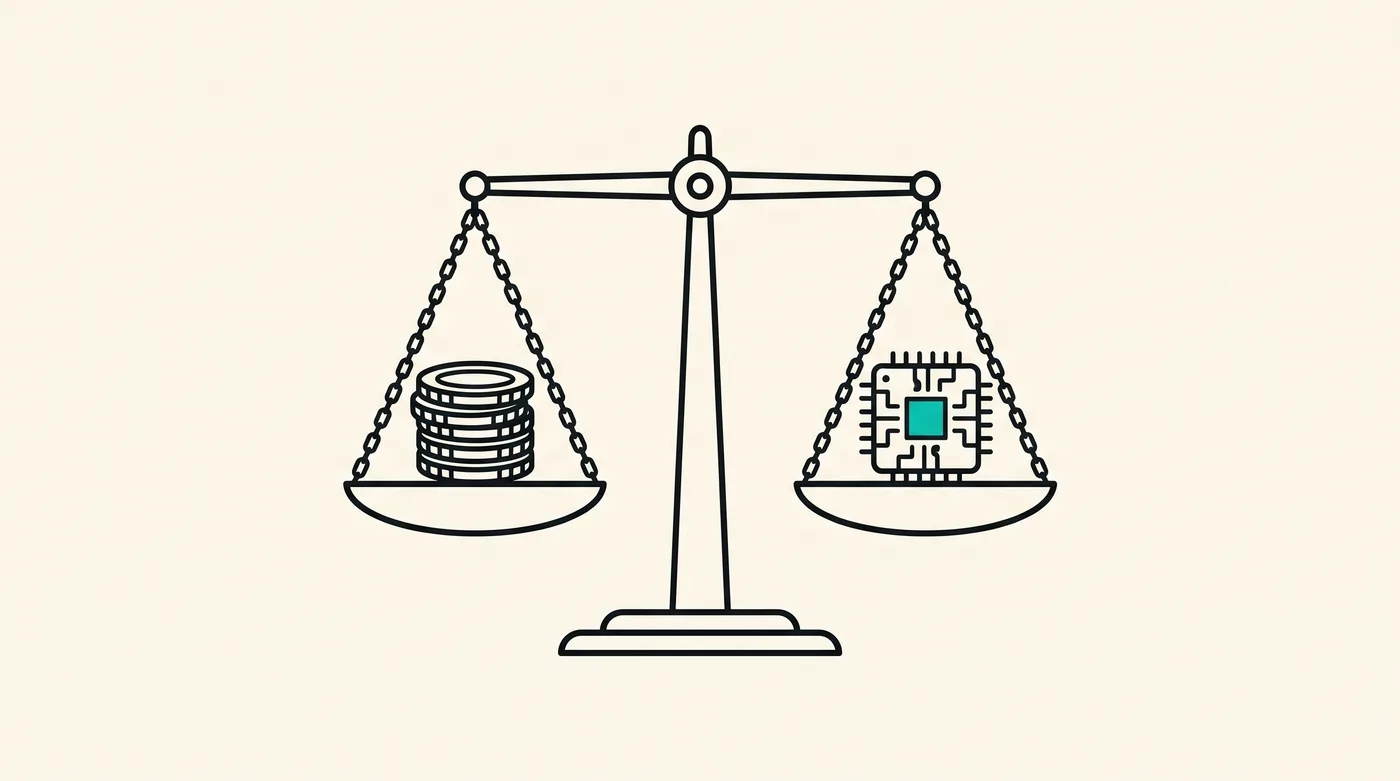
- There is no list price for custom AI. The cost is driven by your specific build, not a menu.
- Five factors set the number: scope, data readiness, integration surface, run-cost, and review burden.
- A bigger scope, messier data, more systems to touch, and higher stakes all push the cost up.
- The honest move is to scope it: get a fixed-fee quote after a short, paid discovery.
"How much does custom AI cost?" is the most-asked question on every AI sales call. The honest answer is that it depends on what you are building — and that is not a dodge. A custom build is custom. Below are the five factors that actually move the number, so you can reason about your own case before you ask anyone for a quote.
A custom AI build is a real investment, not an app-store purchase. Agencies, freelancers, and engineering firms vary widely in what they charge, and quotes from Indian teams tend to run lower than US or UK quotes for equivalent work. None of that tells you your number. These five factors do.
Factor 1: Scope
Scope is the biggest driver. The same word — "AI build" — covers very different shapes of work.
The smallest shape is a single agent that owns one bounded task: triaging support tickets, reading receipts, reconciling invoices, booking appointments. One job, done end-to-end.
The middle shape is a copilot that augments a whole team's daily work — a sales-research assistant, a drafting tool for legal documents, an analysis helper for finance. It touches more of the workflow and more of your data.
The largest shape is a full AI-native rebuild, where you redesign a workflow around AI, build the new system, migrate data, and run it alongside the old one until you switch over. Bigger scope, bigger cost. Pin down which shape you actually need before anything else.
Factor 2: Data readiness
AI runs on your data, so the state of that data sets a large part of the cost. Clean, well-labelled, accessible data is cheap to build on. The work goes straight into the AI.
Messy or locked data adds weeks. If records are scattered across spreadsheets, trapped in PDFs, duplicated, or stuck behind a system with no real export, someone has to untangle that first. That cleanup is real engineering time, and it lands before the AI work even starts.
Before you ask for a quote, look honestly at your own data. Knowing whether it is tidy or tangled is the single best way to predict where your cost will land.
Factor 3: Integration surface
An AI build is rarely a standalone thing. It has to read from and write to the systems you already run — your CRM, your ERP, your helpdesk, your payments. Each connection is its own piece of work.
Connecting to a modern system with a clean API is straightforward. Connecting to an old internal system with no documentation, or a tool that was never meant to be integrated, is much harder. Every system the build must touch widens the integration surface, and each integration is genuine work — not a checkbox.
Count the systems the AI has to talk to. The more there are, and the older they are, the more the integration surface drives the cost.
Factor 4: Run-cost
The build is a one-time cost. Running the system is an ongoing one, and it is easy to forget when you are reasoning about the price. After launch you pay for the model calls the AI makes, the infrastructure it runs on, and the human time spent reviewing its work.
A high-volume, customer-facing agent costs more to run than a quiet internal tool used by a handful of people. The run-cost should shape your decision as much as the build cost does. We break the ongoing numbers down in the economics of AI agents.
Factor 5: Review burden
How much a human has to check the AI's work changes the cost too. Low-stakes work — drafting an internal summary, sorting tickets — needs little oversight. The AI can mostly run on its own.
High-stakes or regulated work is different. When a mistake costs money, breaks a rule, or harms a customer, you need a human in the loop checking the output. That review is a permanent part of the system, and building it well costs more. We cover how to design it in human-in-the-loop AI.
Build vs buy
Before you pay for any custom build, check whether you need one at all. Sometimes a ready-made vertical product already does the job, and it is far cheaper than building from scratch.
Custom is the right call when your workflow is genuinely your own and no product fits it. It is the wrong call when you are about to pay to rebuild something you could buy off the shelf next week. Our build vs buy framework walks through the decision, and our products show what is already built and ready to use.
How to budget for it
Once you understand the five factors, here is how to turn them into a number you can plan around.
- Start with a short, paid discovery. A forward-deployed engineer sits with your team, learns the workflow, and scopes the real build — not a guess.
- Get a fixed-fee quote out of that discovery. A fixed fee aligns the vendor's incentive with shipping; hourly billing rewards drift.
- Avoid open-ended hourly contracts. The scope will grow, and the meter keeps running. Insist on a fixed scope and a fixed price.
- Make sure you own the code. You paid for it; it should be yours, with documentation good enough that another team could take over.
- Keep the discovery spec. Whatever you decide afterward, the written scope is yours to keep and reuse.
That same forward-deployed engineer who runs the discovery is the one who writes the fixed quote. The person who scoped the work stands behind the number.
What this means for you
- Decide which scope you need first — a single agent, a team copilot, or a full rebuild. The cost follows the shape.
- Look honestly at your data and the systems it must touch. Those two factors swing the number the most.
- Budget for the run-cost and the review burden, not just the build. They are ongoing.
- Read the build vs buy framework before you commit to custom at all.
Every Xwits build is scoped and quoted — there is no list price because there is no list build. Tell us the task and we will send a fixed quote. See how a custom build works, or book a call and we will scope your case with you.
Related from the blog
Build vs buy AI: a decision framework
When does an off-the-shelf vertical app win? When do you need a custom build? Seven criteria, a scoring rubric, and an honest answer.
AI consulting vs AI engineering: which one are you actually buying?
A consulting firm sells you a strategy. An engineering firm ships you running software. The difference is bigger than it sounds — and it shows up in the contract.

Why we are not an AI agency
AI agencies sell decks and discovery. We sell working software. The five differences that matter to anyone who has been burned by a six-month "AI transformation."
Talk to a real engineer.
A 30-minute call. We will tell you honestly whether AI is the right fix and what it would take.