AI consulting vs AI engineering: which one are you actually buying?
A consulting firm sells you a strategy. An engineering firm ships you running software. The difference is bigger than it sounds — and it shows up in the contract.
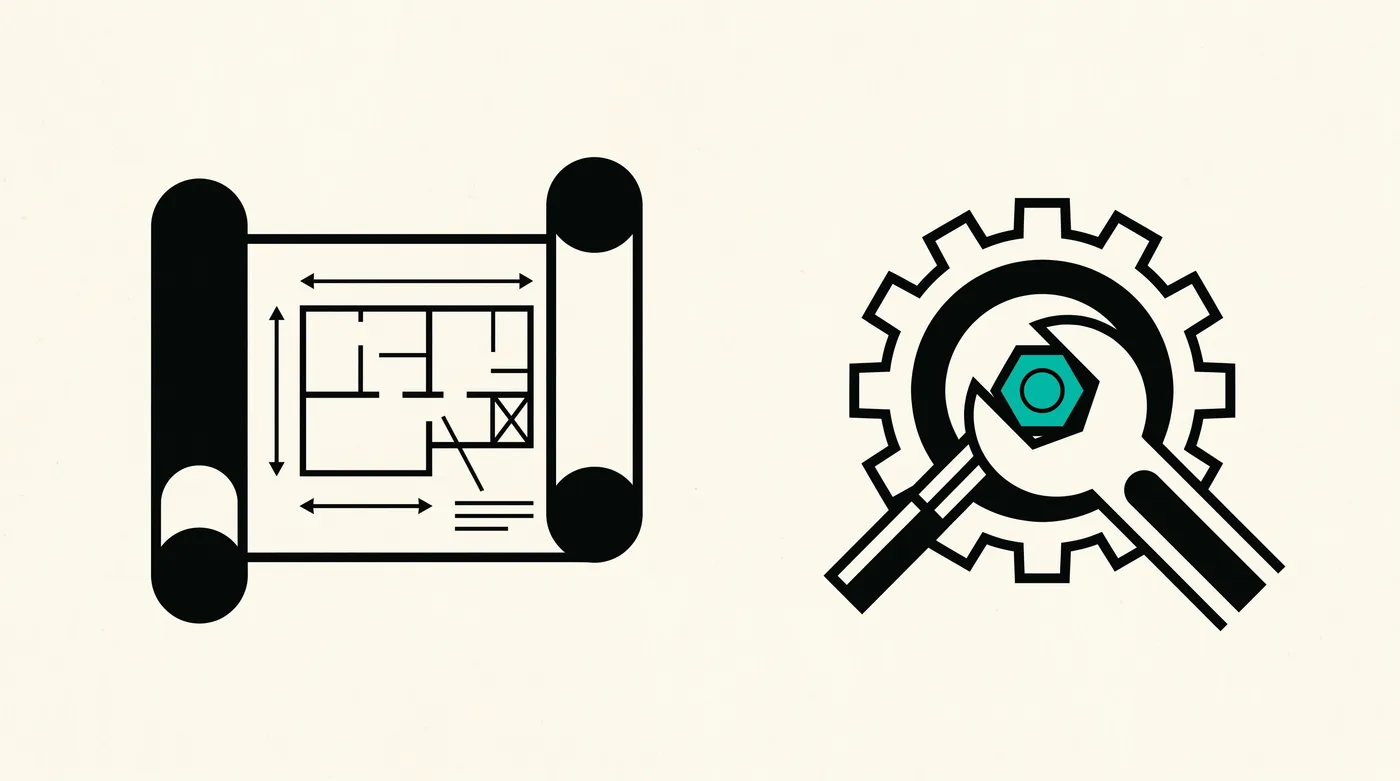
- AI consulting sells you advice. AI engineering ships you software.
- The difference is bigger than it sounds — and it shows up in the contract, the timeline, and the deliverable.
- Most companies need engineering, not consulting. The consulting industry has done a good job of convincing them otherwise.
- When consulting is actually the right call: organisational AI strategy at large enterprises, change management, regulatory navigation.
Two services share the prefix "AI." They are not the same thing. Knowing which one you are buying is the difference between a working product in eight weeks and a 60-slide deck in eight months.
The two deliverables
AI consulting delivers a document. The document is well-researched, full of frameworks, and ends with a recommended roadmap. The recommendation usually starts with "phase one is more discovery." The output is intellectual.
AI engineering delivers software. The software is in production, used by real users, doing the work the consulting document would have recommended. The output is operational.
Both have a place. Most buyers think they need the first when they actually need the second.
The side-by-side
| Dimension | AI consulting | AI engineering |
|---|---|---|
| Primary deliverable | Strategy doc, roadmap, prioritised backlog | Running software in production |
| Pricing model | Hourly or daily rate × consultant-months | Fixed-fee per scoped build |
| Typical engagement length | 3-12 months | 4-8 weeks (per build) |
| Who does the work | Senior consultants, then delivery teams | The engineers who took the sales call |
| Risk of delay | High (more "phases" extend the budget) | Lower (fixed-fee aligns incentives to ship) |
| What you walk away with | A document, possibly some prototypes | Software your team is using |
| Cost | Higher — open-ended, scales with hours billed | Lower — fixed fee, scoped per build |
| Best for | Large enterprises, board-level alignment, regulatory strategy | Operators who know what they need and want it built |
How to tell which one you actually need
Three questions help.
1. Do you know what you want built?
If yes — you need engineering. A consultant will spend three months "validating the requirements" and arrive at the same answer you started with. Skip ahead.
If no, and the problem is genuinely novel — you might benefit from consulting first. Most problems are not genuinely novel.
2. What is the budget shape — capex or opex?
Consulting is opex-shaped: you keep paying for advice. Engineering is closer to capex: you pay to build a thing, then the thing is yours.
If your CFO prefers opex (smaller monthly cheques), consulting fits. If they would rather pay once and own the result, engineering fits.
3. Is the bottleneck "what to do" or "doing it"?
Most companies talking about AI know what they want. The bottleneck is execution capacity, not strategic clarity. Consulting solves the wrong bottleneck.
If your leadership is genuinely split on the strategic direction — and that split is preventing investment — a short consulting engagement to align can pay back. Anything longer is rare to need.
The consulting industry's clever move
Consultancies have spent twenty years training the market to buy advice instead of outcomes. The pattern: sell a strategy engagement, then sell the build that follows the strategy, then sell the change management around the build. Each phase has its own SOW. The total bill is 5-10× what the build alone would cost.
AI made this pattern more dangerous, not less. Because AI is genuinely new, the "we need to figure out AI strategy" pitch lands. By the time the strategy phase ends, the foundation models have moved on twice. The roadmap is stale before it ships.
The pattern that wins: pick one task, build the AI for it, ship it, measure the gain, decide what to build next. Engineering, not consulting, optimises for that loop.
When consulting is genuinely useful
We are not anti-consulting. There are situations where it is the right call.
- Large enterprises with 5,000+ employees where AI adoption requires organisational alignment across business units. Consulting facilitates that alignment in ways an engineering shop cannot.
- Regulated industries where you need a defensible strategy paper before investing — for compliance, board approval, or customer trust.
- Genuinely new domains where no playbook exists yet. The first AI-native bank, the first AI legal practice, etc. — consulting helps build the playbook.
- Change management at scale — when AI will affect hundreds of jobs and the company needs help with the transition.
None of these describe most operators. Most operators know their workflow, know where AI would help, and need execution.
Why we built Xwits as engineering, not consulting
We picked engineering as our shape because the consulting market is well-served and the engineering market is not. There are excellent AI consultancies. There are very few AI engineering firms that ship in weeks at a fixed fee.
We built Xwits Engineering — our autonomous AI delivery platform — specifically so a small team can ship the kind of build that an agency would charge consultant-months for. The savings are passed on as a lower fixed quote.
What this means for you
- If you have a clear "we should build X" thought, skip consulting and talk to an engineering firm. Like us. Or anyone who ships at a fixed fee.
- If you are at a 10,000-person enterprise and three business units disagree on AI direction, consulting first might genuinely help. Then engineering.
- If you are between the two, the cheapest experiment is a one-week paid scoping exercise — most engineering firms (including ours) offer this. It tells you whether the build is well-defined enough to skip the strategy phase.
- Read Why we are not an AI agency for the closely-related view.
- Read How much does custom AI cost for the real ranges.
Book a 30-minute call if you want a candid second opinion on which shape fits your situation.
Related from the blog

Why we are not an AI agency
AI agencies sell decks and discovery. We sell working software. The five differences that matter to anyone who has been burned by a six-month "AI transformation."
Build vs buy AI: a decision framework
When does an off-the-shelf vertical app win? When do you need a custom build? Seven criteria, a scoring rubric, and an honest answer.

How much does a custom AI build actually cost? (2026 ranges)
Real ranges by scope: a single agent vs an internal copilot vs a full AI-native rebuild. What drives the number up — and what is overpriced if you are being quoted it.
Talk to a real engineer.
A 30-minute call. We will tell you honestly whether AI is the right fix and what it would take.