The marketing tools AI replaces (and the ones it does not)
An honest list of what AI marketing automation can replace today, what to keep, and what is still a year away. Saves you from buying the wrong stack.
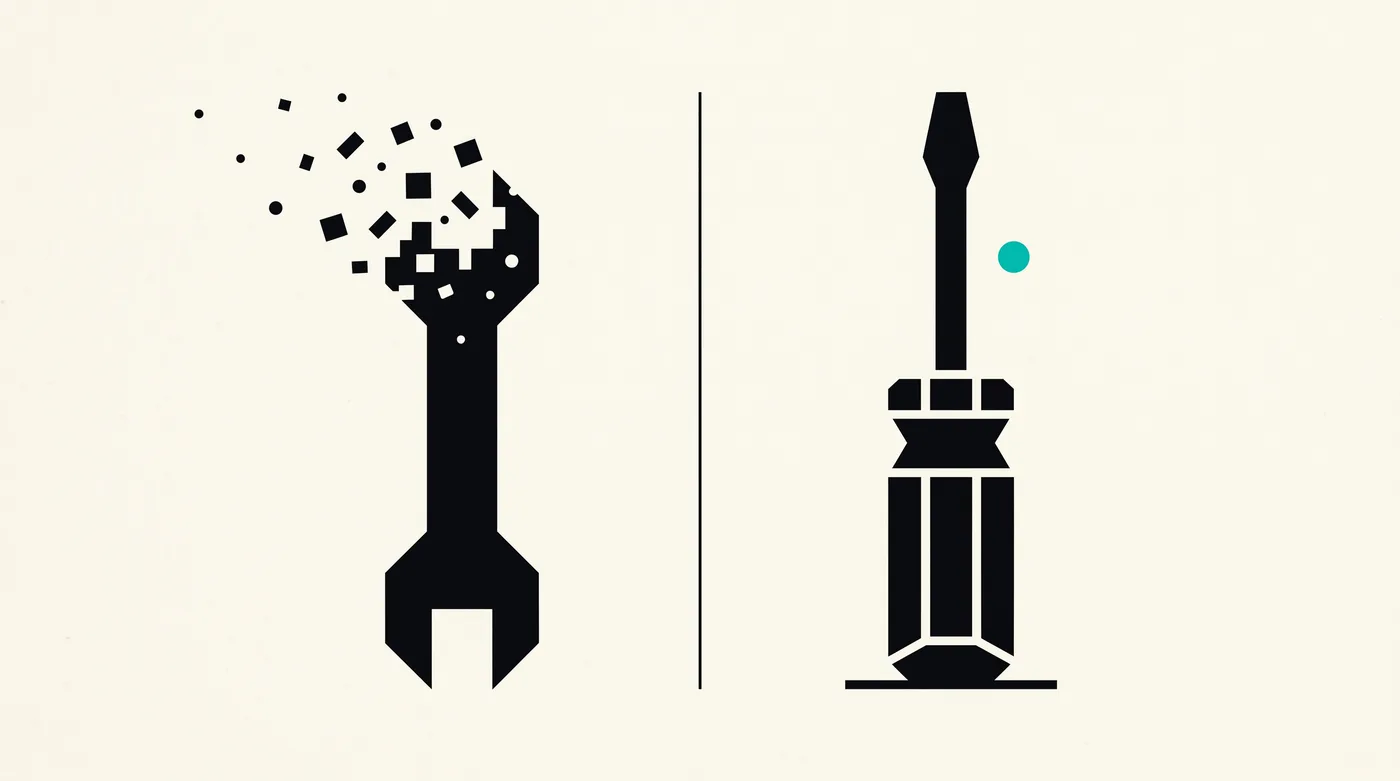
- AI marketing automation replaces 6 categories of tool: scheduler, copy tool, design tool, email tool, basic analytics, drip-flow tool.
- It does not replace: CRM, the website CMS, ad-buying platform, customer-data warehouse, broadcast-quality video production.
- One year away from replacement: CRM-style relationship intelligence, ad-creative testing at scale.
- Save you from buying the wrong stack: do not pay for tools whose categories are about to collapse.
Marketing tooling is consolidating faster than most CFOs realize. A typical SMB has 8-12 marketing tools today. AI marketing automation collapses that to 2-3. Below is the honest list of what gets replaced, what does not, and what is on the borderline.
Replaced today (do not renew)
1. Schedulers — Buffer, Hootsuite, Sprout Social
Scheduling was the original "marketing automation" category. AI marketing automation includes scheduling as a side-effect — the system is already generating the content; queueing it is trivial. Standalone schedulers are about to become a thin layer that nobody buys.
Action: Let your scheduler subscription lapse. Replace with AI marketing automation.
2. AI copywriting tools — Jasper, Copy.ai, Writesonic
First-generation "AI for marketers" was a wrapper around GPT for generating headlines and posts. The category survives only by attaching scheduling + collaboration — which is what AI marketing automation already does, better integrated.
Action: Replace standalone AI copy tools. The output quality of an integrated system is higher because it knows your brand voice from past content.
3. Design tools for social-format work — Canva (for posts), Adobe Express
For the high-volume "feed post, story, Reel cover" work, AI image generation + brand-template-based composition is now good enough. Canva survives for the bespoke (a brochure, a one-pager, a printed flyer). The daily social grind moves to AI.
Action: Keep Canva for non-social. Stop using it for posts.
4. Email tools (transactional + drip) — Mailchimp, ConvertKit, Mailerlite
Email composition, list segmentation, drip flow design — all included in AI marketing automation. The standalone email tool survives only for very specific use cases (high-deliverability transactional, complex multi-step e-commerce flows). Most SMBs use 5% of Mailchimp's features; that 5% is now baked into the marketing-autopilot category.
Action: Migrate. Keep Mailchimp only if you have complex e-commerce drip flows.
5. Basic per-channel analytics dashboards
The "look at your Instagram performance" dashboards. AI marketing automation generates a weekly plain-English report covering every channel — replacing the need to log into 5 dashboards. The dashboards themselves still exist (Instagram Insights is free); paying for a third-party aggregator dashboard is no longer worth it.
Action: Cancel the aggregator. Use native + the AI weekly report.
6. Simple drip-flow tools — ActiveCampaign, Drip
"If user does X, send email Y" — AI marketing automation handles this with conversational logic that doesn't require you to build a 12-node flowchart. Standalone drip-flow tools survive for complex B2B nurture sequences where the flow IS the product.
Action: Replace for SMB use. Keep for high-touch B2B nurture.
NOT replaced (keep paying)
1. CRM — HubSpot, Salesforce, Pipedrive
AI marketing automation does not own your relationships. Customer records, deal pipeline, conversation history with sales — all stays in CRM. AI marketing automation feeds the CRM (every reply becomes a record) but doesn't replace it.
See AI for sales for what AI does inside the CRM.
2. Website CMS — WordPress, Webflow, Shopify
Your website is the product page; AI marketing automation drives traffic to it. CMS replacement is a 10-year story, not a 2026 one.
3. Ad-buying platforms — Meta Ads Manager, Google Ads
AI marketing automation can ship the creative; it does not own the auction or the bidding strategy. Ad-buying platforms keep their full role. Some AI tools are emerging for ad creative testing (next section), but the platform itself is not going anywhere.
4. Customer data warehouse — Segment, mParticle, RudderStack
AI marketing automation reads from your data warehouse; it does not become one. If you have meaningful customer-level data, you still need the warehouse.
5. Broadcast-quality video production
AI video (Sora, Runway, etc.) is great for B-roll and storyboards. It is not yet ready for hero spot production. The video production agency / freelancer keeps the role for one or two more years. See overhyped AI use cases.
Borderline — one year away
CRM-style relationship intelligence
Tools like Clay, Apollo's enrichment layer — the AI-enrichment-on-top-of-CRM category. Currently separate products; in 2027 the CRM itself will absorb most of this, and standalone tools will compress to specialized niches.
Ad-creative testing at scale
Tools that auto-generate 50 ad variants and let the platform's algorithm find the winner. Mid-quality today; the integrated future is "AI marketing automation drafts 5 carefully chosen variants, human picks 2, platform optimises between them." Skip the "generate 50 variants" tools — see overhyped use cases.
SEO tooling — Ahrefs, Semrush
Keyword research + competitive analysis. The data layer survives; the workflow on top gets absorbed into AI tooling. Two-year horizon.
How to plan the migration
For an SMB on a typical $300-1500/month stack:
- Month 1: set up the AI marketing automation tool. Keep existing tools running in parallel.
- Month 2: migrate one channel first (typically email or Instagram). Don't migrate everything.
- Month 3: if month 2 worked, migrate the next channel. Cancel the now-redundant standalone tool.
- Month 4-6: migrate remaining channels one at a time. By month 6 you are down to AI marketing automation + CRM + CMS + ad platforms.
Skip the "rip and replace" approach. Marketing breaks loudly when it breaks; never break it on purpose.
What this means for you
- Six categories of marketing tool are getting absorbed into AI marketing automation. Stop renewing.
- CRM, CMS, ad platforms, data warehouse, broadcast video — these stay.
- Borderline (one year away): relationship intelligence, ad creative testing, SEO research.
- Migrate one channel at a time. Never rip-and-replace.
- Marketing Autopilot is our take on this consolidation — Founding Partner beta Q3 2026.
- Read the brand-voice problem in AI marketing next.
Auditing your marketing stack? Book a 30-minute call. We will tell you which subscriptions to cancel today.
Related from the blog
What is AI marketing automation? A guide for SMBs
Pillar post. AI marketing automation is more than scheduling — it is campaign planning, content drafting, multi-channel publishing, and analytics, all under one brand voice. Five characteristics + when it makes sense.
Multi-channel campaign planning with AI: a 30-day template
A 30-day campaign planning template you can copy this week. Calendar, channel mix, asset list, approval flow, measurement plan. Built for the operator who plans on Sunday night.
Build vs buy AI: a decision framework
When does an off-the-shelf vertical app win? When do you need a custom build? Seven criteria, a scoring rubric, and an honest answer.
Talk to a real engineer.
A 30-minute call. We will tell you honestly whether AI is the right fix and what it would take.