How to build an AI-native marketing team
What an AI-native marketing team actually looks like. Three roles to keep, two to redesign, the daily rhythm, and the artefacts that compound. For 5-50 person teams.
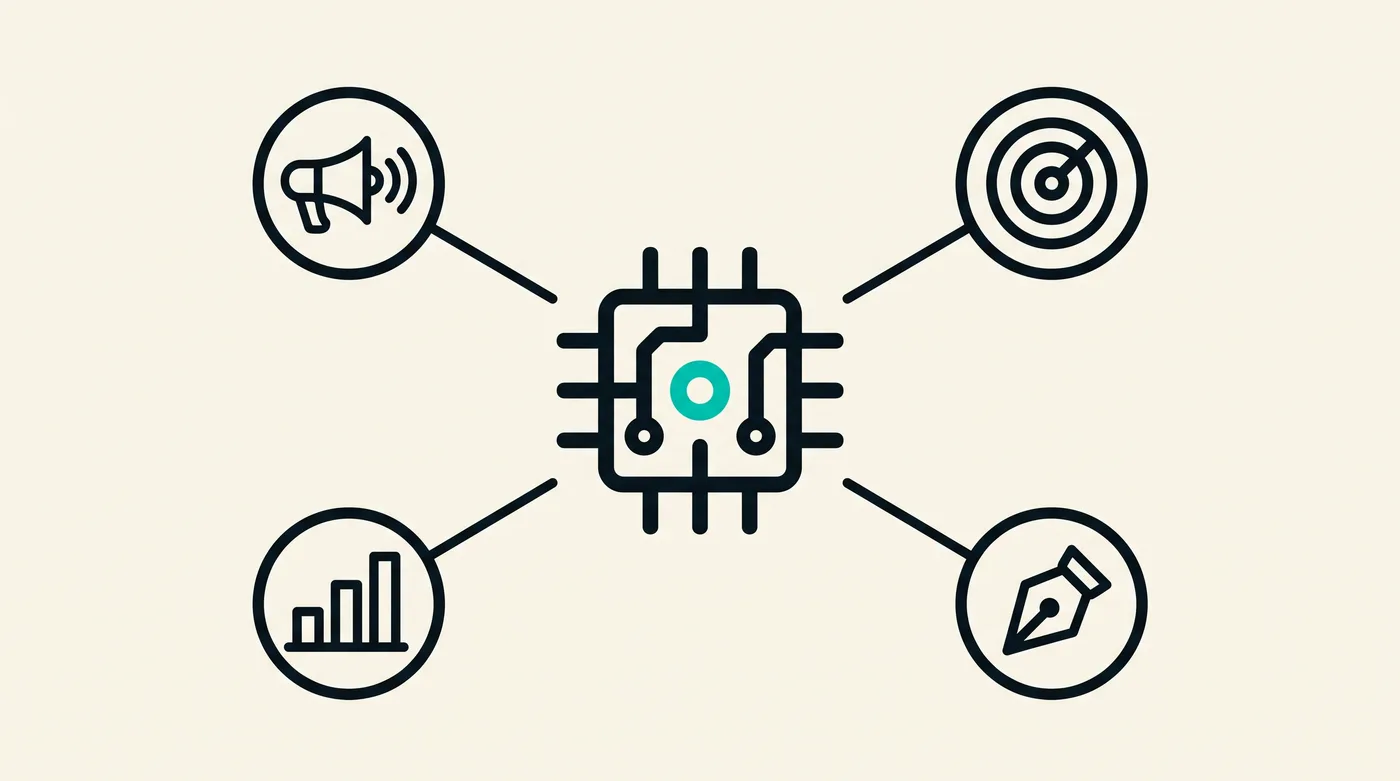
- An AI-native marketing team is 3-5 humans + an AI marketing system that does the volume work.
- Three roles to keep: strategist, brand-voice owner, channel relationship lead. Two to redesign: the writer, the scheduler.
- Daily rhythm: morning digest, mid-day approval pass, weekly campaign review.
- Artefacts that compound: brand voice rubric, channel performance log, evergreen content bank.
Most "AI in marketing" advice is about tools. The real question is roles. Below is the working shape of an AI-native marketing team in 2026.
The three roles to keep
1. Strategist (the marketing lead)
Owns the quarterly question: who are we serving, what are we selling, how do we win this quarter? AI cannot answer this. It can model competitors, surface trends, summarize feedback — but the call is human. Usually the founder for the first 3 years, then a dedicated head of marketing.
2. Brand-voice owner (the editor)
Decides what good content looks like. Reviews AI output. Tunes the voice rubric. Catches drift. This is half-time-on-AI, half-time on the things AI cannot do (interviews, original research, customer stories). The classic "in-house writer" role evolves into this.
3. Channel relationship lead
Owns the partnerships AI cannot have. The local journalist. The micro-influencer. The customer who became a champion. The community manager who responds in DMs. AI can draft a reply; it cannot build a relationship.
The two roles to redesign
The writer → editor + producer
The job used to be writing 20 posts a week. Now AI drafts the 20. The role is reviewing them, picking the 3 that need rework, and writing the 1 that needs original perspective. Throughput per writer goes 3-5×; the work becomes more about judgement, less about typing.
See how to write good prompts for the AI-side of the craft.
The scheduler → ops + analyst
Scheduling was a 4-hour-a-week job — copy from the calendar, paste into Buffer, check the preview. AI marketing automation collapses this to 15 minutes of approval. The scheduler's old hours become: looking at what's working, tuning the channel mix, escalating exceptions.
The daily rhythm
Morning (20 minutes)
- Read the overnight AI digest: what shipped, what was held for review, what flagged as off-brand
- Triage the approval queue — bulk approve the obvious, send 2-3 back for revision
- Note anything that looks like brand-voice drift
Midday (45 minutes)
- Review the next 7 days of scheduled content
- Approve the campaign-level moves (drops, launches, festival posts)
- Handle the exceptions — anything the AI escalated
Weekly (90 minutes — typically Friday)
- Run the eval: 20 random posts from the week — are they on-brand?
- Look at channel performance — which channels are slipping?
- Update the voice rubric if anything new emerged
- Plan the next campaign brief; AI generates the calendar from it
Monthly
- Brand-voice drift audit — is the AI output still recognizably you?
- Cost-per-result review — is the math still working?
- Strategy sync with the founder/leadership
See the AI-native operator playbook for the parallel rhythm in other functions.
The three artefacts that compound
1. Brand voice rubric
A one-page document the AI is trained on: tone (5 adjectives we are, 5 we are not), vocabulary (terms we use, terms we don't), sentence rhythm (preferred length, paragraph cadence), reference examples (5 of our best). Update quarterly.
2. Channel performance log
Per-channel running notes: what's been working, what's been slipping, when audiences shift. AI generates the weekly numbers; the human writes the "why." Becomes the memory of your marketing.
3. Evergreen content bank
Every original piece of content (interview, customer story, original research) goes into a bank. AI references it when generating campaigns. The bank compounds — month 6 your AI is 3× as good as month 1 because it has 3× the source material to ground in.
What size team needs this
- 1-3 people total business: founder owns all 3 keep-roles. AI marketing system handles the volume. Use Marketing Autopilot as the off-the-shelf option.
- 10-50 person business: 1-2 marketers (strategist + editor) + AI marketing system. Hire the channel relationship lead as you scale.
- 50-200 person business: 3-5 marketers covering the three keep-roles + AI marketing automation. The editor role may split into voice owner + producer.
Hiring filters
For each of the three keep-roles:
- Strategist: can articulate a positioning thesis in 90 seconds. Has run a real campaign with measurable outcome. Comfortable saying "we don't have that data."
- Brand-voice owner: can show you 3 examples of "good" and "bad" output and explain why. Reads a lot. Cares about commas.
- Channel relationship lead: already has a network you would want to inherit. Comfortable on camera and in DMs. Patient with slow-cooking relationships.
Skip: candidates who lead with "I'm great at AI tools." The tools change. The judgement does not.
See how to hire your first AI engineer for the engineer-shaped version of this.
What this means for you
- An AI-native marketing team is small + an AI system, not a big team using AI tools.
- Three roles to keep: strategy, voice, relationships. Two to redesign: writer → editor, scheduler → ops.
- Daily rhythm: morning digest, midday approval, weekly review.
- Compounding artefacts: brand voice rubric, channel performance log, evergreen bank.
- Marketing Autopilot is the AI system part — Founding Partner beta in Q3 2026.
- Read building an AI-native culture next.
Designing your AI-native marketing team? Book a 30-minute call. We will sketch the org chart with you.
Related from the blog

What is AI marketing automation? A guide for SMBs
Pillar post. AI marketing automation is more than scheduling — it is campaign planning, content drafting, multi-channel publishing, and analytics, all under one brand voice. Five characteristics + when it makes sense.
The AI-native operator playbook: a daily rhythm
What an AI-native operator actually does on a Tuesday. The morning digest, the approval queue, the quality reviews, the end-of-day handoff. A new operating rhythm.
Building an AI-native culture in a 10-person team
Culture is the bottleneck after tooling. Five rituals, three artefacts, and the meeting we deleted. How a small team learns to ship with AI in the loop.
Talk to a real engineer.
A 30-minute call. We will tell you honestly whether AI is the right fix and what it would take.